Cleaning teams and staff are often inside the property at the most important moment: turnover. With the right workflow, they can help capture condition before and after cleaning while the landlord keeps control of review and reporting.
Property turnover is one of the most important moments in rental management
The renter has moved out. The property may need cleaning, maintenance, repairs, or preparation for the next tenant. The landlord needs to understand the condition of the unit, but the landlord may not be the first person inside the property.
Often, the cleaning team is there first. A staff member may see the property before cleaning starts. A turnover helper may notice missing items, damage, stains, or maintenance issues. A cleaner may know what the property looked like before and after cleaning.
That makes staff and cleaning teams valuable capture helpers.
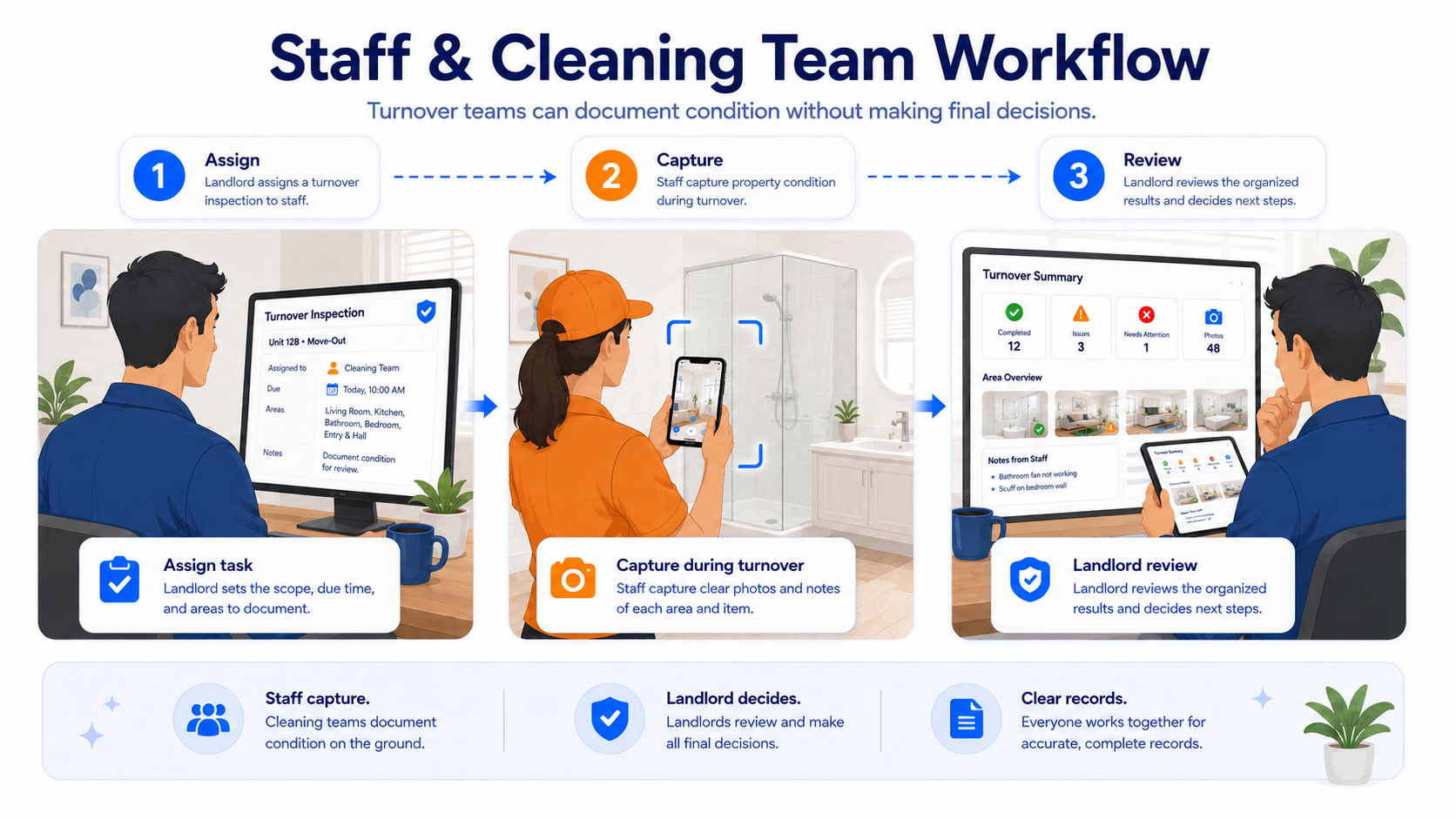
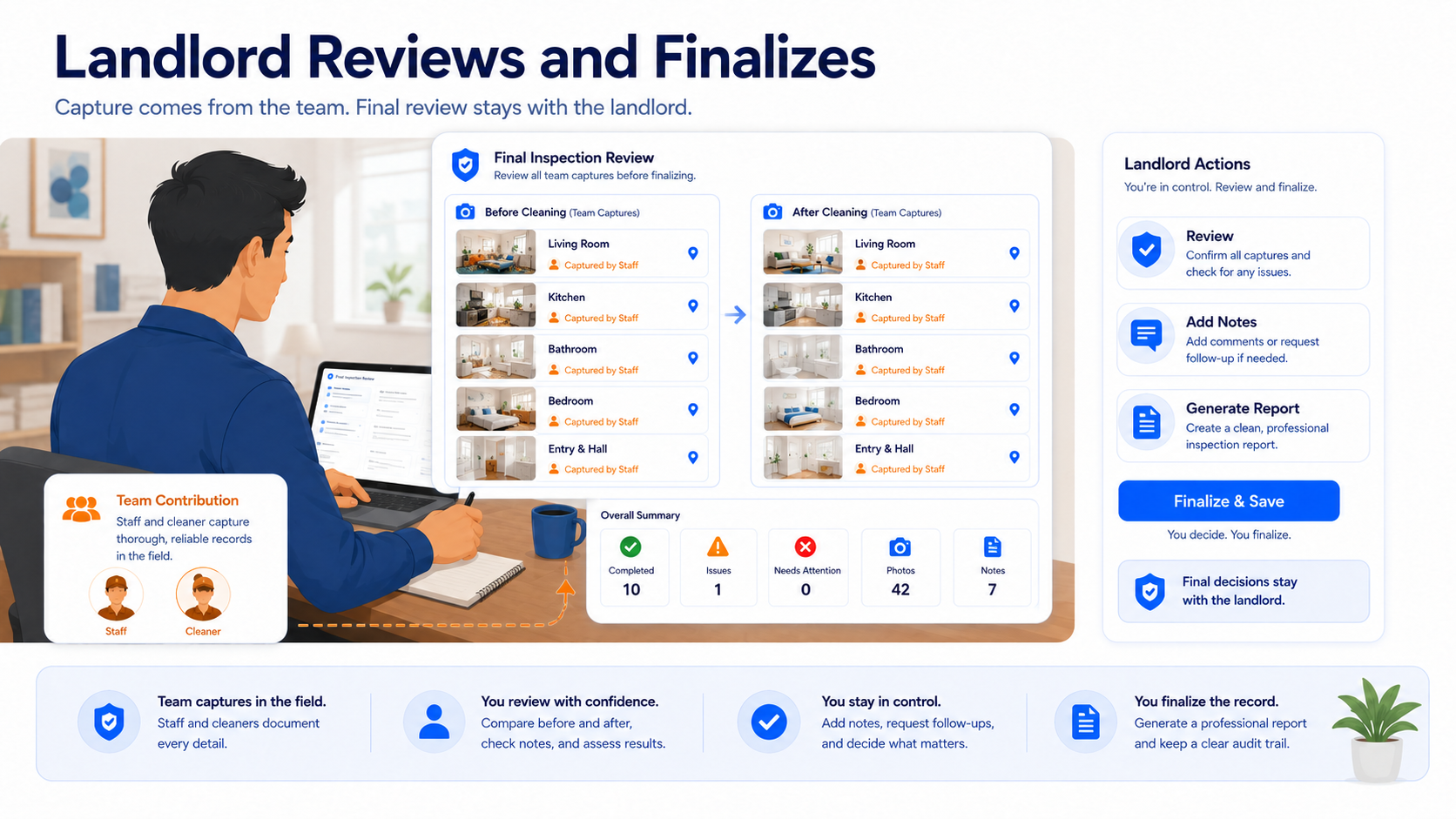
But there is one important rule: staff and cleaners can help document condition. The landlord should still review and decide.
PropCheckAI is designed to support this type of workflow:
Landlord assigns the inspection→Staff or cleaners capture condition→Landlord reviews the record→Landlord finalizes the report
The capture work can be shared.
The final review stays controlled.
Why turnover is the perfect time to document condition
Turnover is when the property changes from one occupancy cycle to the next. This is when the property may be empty, partially cleaned, fully cleaned, waiting for maintenance, ready for repair, ready for a new renter, or waiting for landlord review.
This is also when important details can be missed. If the cleaning team enters first and moves items, throws away debris, cleans stains, or shifts furniture, the original move-out condition may be harder to document later.
That does not mean cleaning should be delayed. It means the condition should be captured at the right moments.
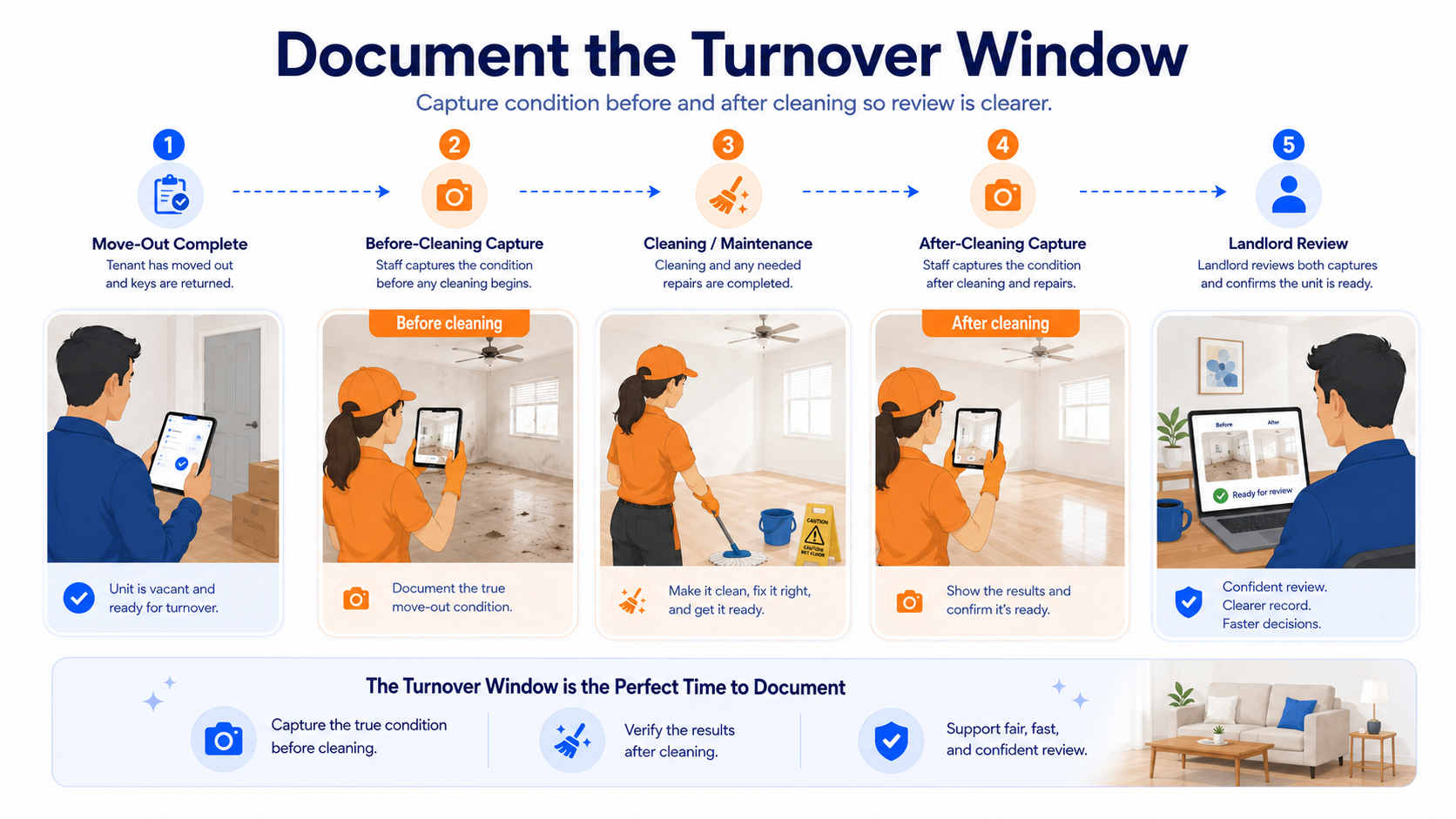
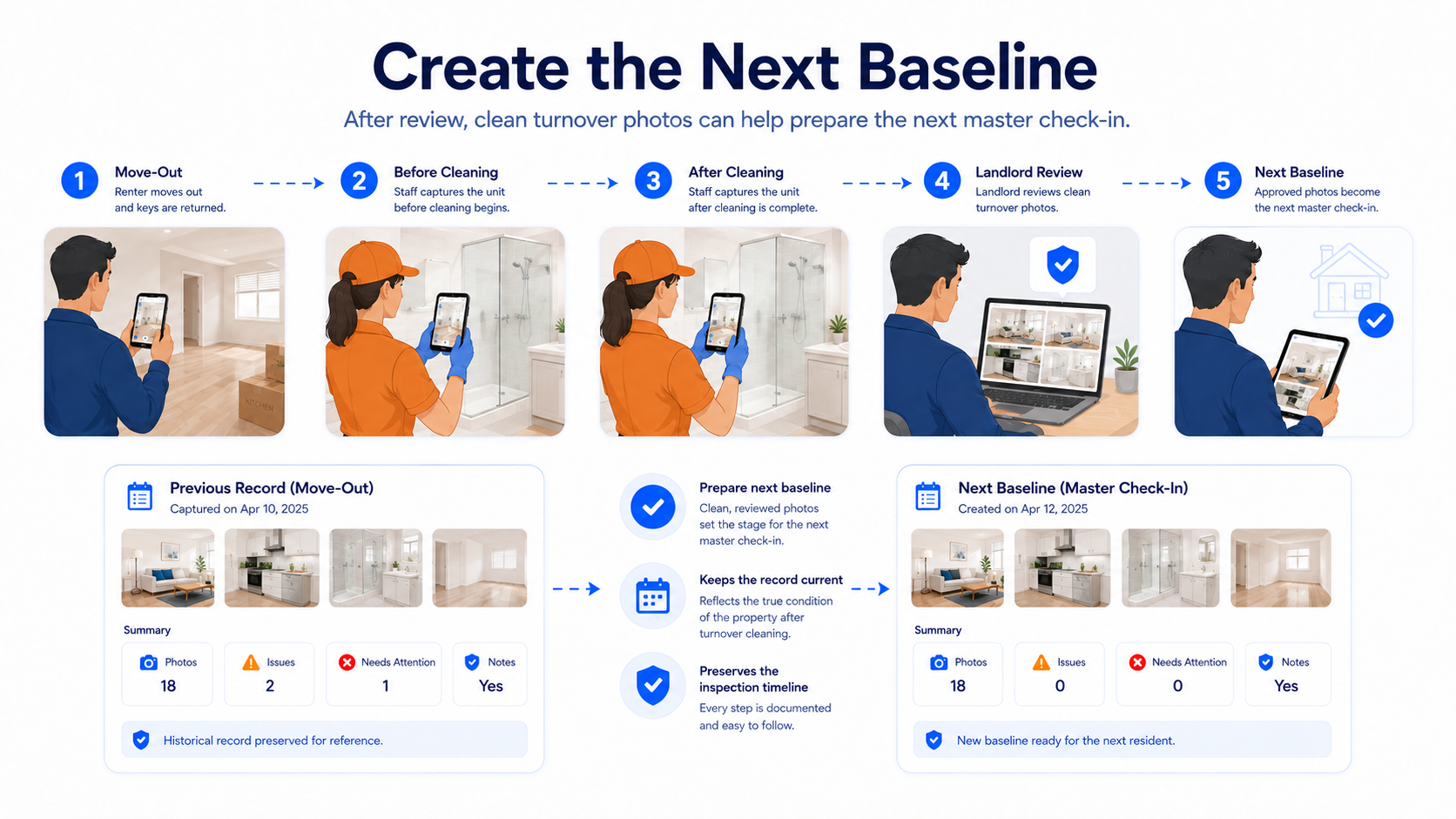
A strong turnover workflow usually includes:
Move-out complete
Before-cleaning capture
Cleaning or maintenance
After-cleaning capture
Landlord review
Next baseline preparation
This creates a clearer timeline. The landlord can see what the property looked like before cleaning, what changed after cleaning, and what still needs attention.
Staff capture is not the same as final review
Staff and cleaning teams can document what they see. That does not mean they make final decisions. A cleaner should not have to decide whether something is tenant-caused damage. A staff member should not have to decide whether something should be charged. A turnover helper should not have to make legal or financial conclusions.
Their job is simpler: capture the visible condition clearly. The landlord’s job is different: review the record, add context, and decide what belongs in the final report.
This separation matters. It lets staff and cleaners contribute useful documentation without putting final responsibility on them.
Before-cleaning capture: document the property as it was found
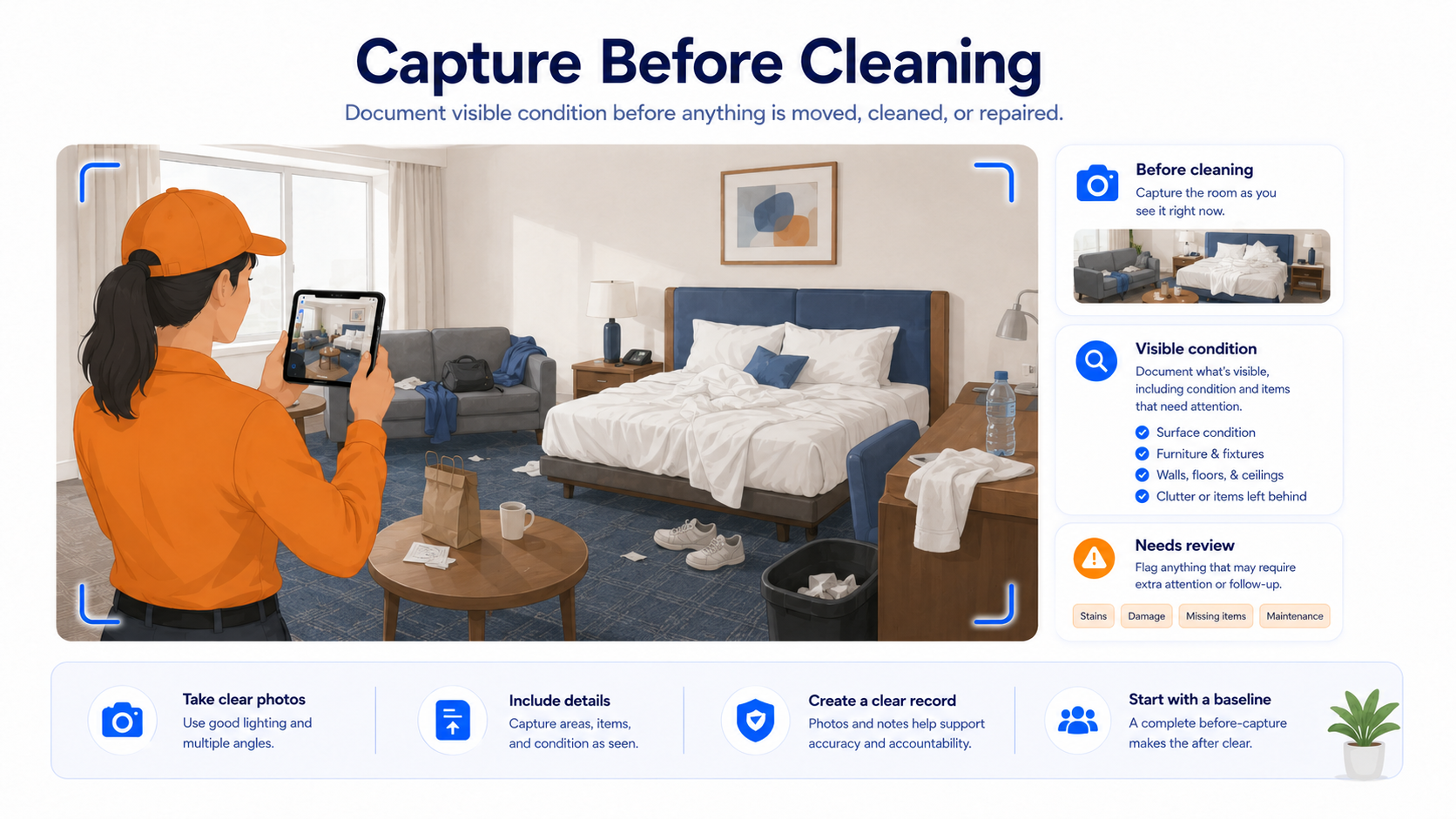
Before-cleaning capture is one of the most useful steps in the turnover workflow. This is the record of what the property looked like before cleaning, moving, repairing, or resetting the space.
The goal is not to blame anyone. The goal is to document visible condition.
Before cleaning, staff or cleaners may capture:
overall room condition
items left behind
visible stains
floor condition
wall marks
bathroom condition
kitchen condition
furniture or fixture condition
missing or moved items
areas that may need maintenance
areas that need landlord review
This record can help the landlord understand what the team saw when they entered the property. It can also help separate two different questions: what was the condition before cleaning, and what was the condition after cleaning?
Keep before-cleaning notes factual
Before-cleaning notes should be short and factual.
Good examples:
“Items left on living room floor.”
“Visible marks near bedroom wall.”
“Bathroom sink area captured before cleaning.”
“Kitchen counter condition documented before cleaning.”
“Possible maintenance follow-up needed near hallway baseboard.”
Avoid emotional or legal wording. Staff and cleaning teams should document what is visible. The landlord can review the record later and decide what matters.
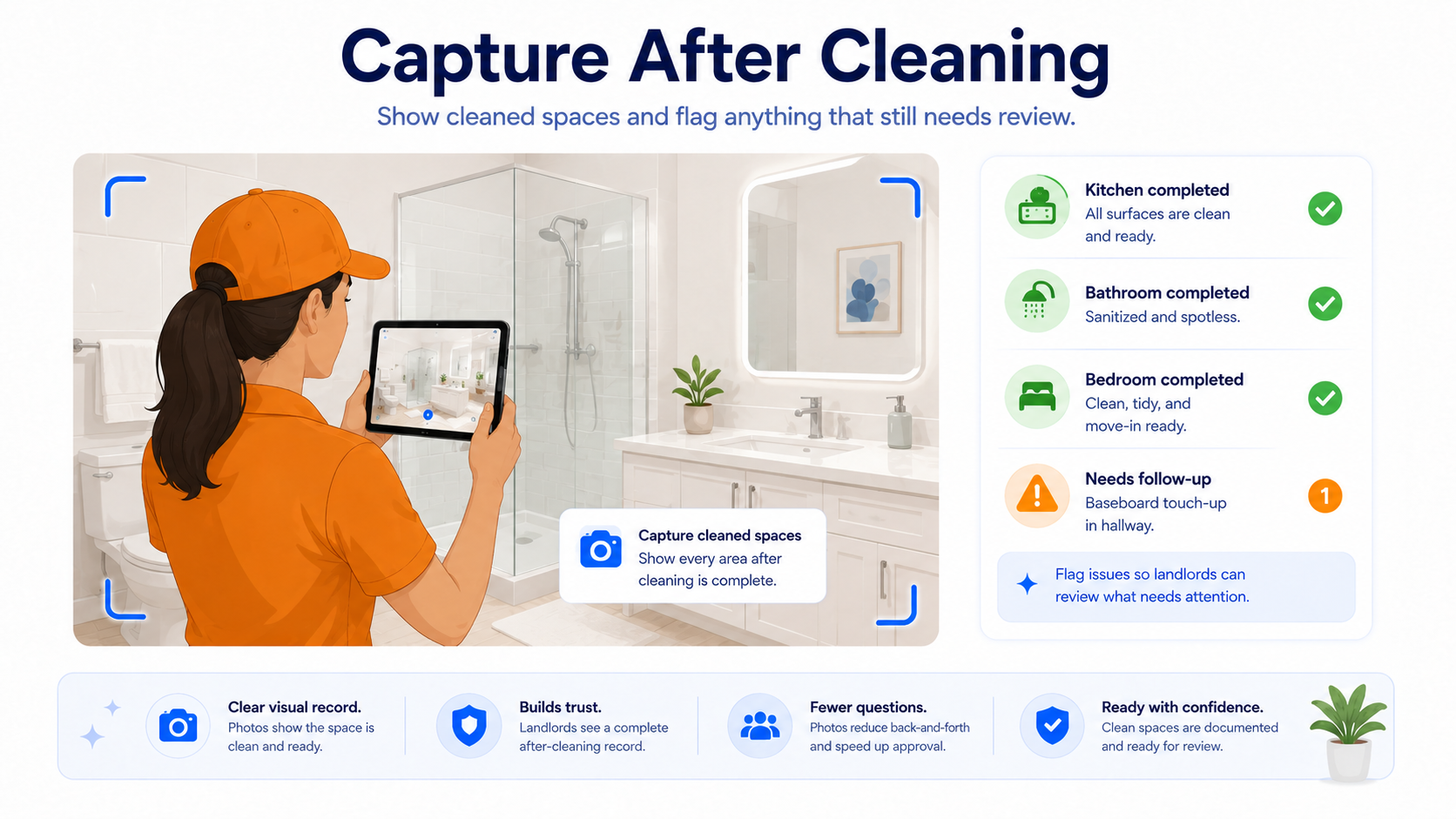
After-cleaning capture: show the final visible condition
After-cleaning capture is just as important. Once the property is cleaned, the space may look completely different. This creates a useful record of the condition after turnover work.
After-cleaning capture can show:
cleaned rooms
completed areas
remaining issues
areas needing follow-up
maintenance items still visible
rooms ready for review
cleaned fixtures and surfaces
final condition before the next inspection cycle
This helps the landlord see what was completed and what still needs attention. A cleaner may not know whether a remaining issue is important, normal wear, or something requiring action. That is fine. The cleaner can flag it for review. The landlord decides what to do next.
Cleaning teams can reduce blind spots
Cleaning teams often notice details that landlords may not see immediately. They may notice stains that do not come out, broken fixtures, missing small items, unusual odors, clogged drains, damaged surfaces, loose handles, marks behind furniture, areas that need maintenance, or rooms that require extra work.
These observations can be useful. But they should be captured in a structured way. Instead of sending random text messages or scattered photos, staff and cleaning teams can support a room-based inspection workflow.
This makes the record easier to review later.
Why random cleaner photos are hard to use later
Many landlords already ask cleaning teams to send photos. The problem is that informal photo sharing can quickly become messy. Photos may arrive through text messages, WhatsApp, email, cloud folders, shared albums, random file uploads, or staff group chats.
Later, it can be hard to answer basic questions: Which property is this? Which room is this? Was this before cleaning or after cleaning? When was this captured? Who captured it? Was this issue already reviewed? Did this photo make it into the final report? Is there an after-cleaning photo from the same room?
This is why structure matters. A staff and cleaning workflow should connect each capture to the property, the room, the inspection type, the capture time, the staff or cleaner role, the landlord review process, and the final report or next baseline.
Before and after cleaning records create better context
A single photo can be helpful. A before-and-after cleaning record is more useful.
For example, before-cleaning capture may show a dirty kitchen counter. After-cleaning capture may show the counter cleaned and ready. That tells a clearer story than either photo alone.
Before and after cleaning records can help show what the cleaner saw when they arrived, what was cleaned successfully, what still needs follow-up, what changed during turnover, what the landlord should review, and whether the property is ready for the next step.
This does not replace landlord judgment. It gives the landlord better context.
Staff and cleaners should not make final decisions
This point is important enough to repeat. Staff and cleaning teams should not be treated as final decision-makers for damage, charges, claims, or legal responsibility.
They are helping capture condition. They are not deciding responsibility. They are not approving charges. They are not creating legal conclusions. They are not replacing landlord review.
After staff or cleaners capture before-cleaning and after-cleaning records, the landlord can review everything in one place. The landlord can check whether each room was captured, whether before-cleaning photos are complete, whether after-cleaning photos are complete, whether any areas need follow-up, whether staff notes need clarification, whether additional photos are needed, whether findings should be included in a report, and whether the property is ready for the next baseline.
This is where the landlord adds judgment. Staff provide field capture. The landlord provides review and decision-making.
Staff notes should support review
Staff notes do not need to be long. Short, factual notes are usually best.
Good staff notes:
“Bathroom fan not working.”
“Scuff visible on bedroom wall.”
“Kitchen cleaned after checkout.”
“Baseboard touch-up may be needed in hallway.”
“Living room captured before and after cleaning.”
Avoid unclear or overreaching notes. The note should help the landlord review the issue. It should not replace the landlord’s decision.
Turning after-cleaning photos into the next baseline
A strong turnover workflow does not stop after cleaning. After the property has been cleaned and reviewed, the after-cleaning capture can become a useful starting point for the next inspection cycle.
This is powerful. The landlord can review the after-cleaning record, confirm the condition, and use those clean turnover photos to help prepare the next master check-in for the next renter. This does not mean deleting or overwriting the old record.
The historical move-out and turnover records should remain part of the inspection timeline. Previous record stays preserved. Clean reviewed turnover photos help prepare the next baseline.
That means the property record keeps moving forward.
Why the next baseline matters
Every new tenancy should start from a clear condition record. If the property was cleaned, repaired, or reset after the previous renter moved out, the old move-in baseline may no longer represent the current condition.
That is why the reviewed after-cleaning record is useful. It can help the landlord prepare the next master check-in with fresh, current condition information.
Helpful situations include when the property has been cleaned, repairs were completed, missing items were replaced, maintenance was performed, walls or floors were touched up, or the property is ready for the next renter.
The goal is to keep the baseline current without losing history.
The inspection timeline should stay intact
The inspection timeline matters. The old record should remain available. The move-out record should remain available. The before-cleaning capture should remain available. The after-cleaning capture should remain available. The next baseline should become its own updated reference point.
This is what makes the record more trustworthy and easier to understand. Instead of a messy folder of disconnected photos, the property has a timeline: what it looked like before, what it looked like at move-out, what it looked like before cleaning, what it looked like after cleaning, and what becomes the next baseline.
That is a better property record.
Why this helps landlords manage more properties
Staff and cleaning workflows are especially useful when landlords manage more than one property. Without delegation, the landlord becomes the bottleneck. Every inspection depends on the landlord being physically present.
With a staff and cleaning workflow, the landlord can keep the process moving: staff capture condition, cleaners document turnover, before-cleaning records are saved, after-cleaning records are saved, landlord reviews later, reports are generated when needed, and next baseline preparation becomes easier.
The landlord does not lose control. The landlord gains a better workflow.
Why this helps cleaning teams
Cleaning teams benefit from a clear workflow too. Instead of trying to explain everything by message, they can capture what they see and move through the room list.
A clear workflow helps cleaning teams know what rooms to capture, when to capture before-cleaning condition, when to capture after-cleaning condition, what notes to add, what issues to flag, and what does not need to be decided by them.
This makes the cleaner’s role simpler. They document condition. They do not make final decisions.
Why this helps property managers and staff
Property managers and staff often coordinate between landlords, renters, cleaners, and maintenance workers. A structured staff workflow can help reduce confusion.
Staff can document move-out condition, areas needing repair, cleaning progress, post-cleaning condition, maintenance follow-up, room readiness, and photos for landlord review.
This creates a better handoff. The landlord or responsible manager can review the record without chasing information across messages, folders, or phone calls.
What a strong staff and cleaning workflow includes
A strong workflow should include:
assigned turnover task
clear room list
before-cleaning capture
after-cleaning capture
short staff notes
issue flags for review
landlord review
final report generation when needed
next baseline preparation after review
The workflow should be simple enough for staff and cleaning teams to follow. The landlord should not need to explain the process from scratch every time.
What staff and cleaning workflows should not do
Staff and cleaning workflows should not create confusion about responsibility. Avoid wording or workflow design that implies cleaners decide tenant responsibility, staff approve charges, cleaning companies make legal conclusions, staff determine what is normal wear, AI proves damage automatically, the app guarantees dispute outcomes, old records are overwritten or deleted, or after-cleaning photos automatically replace the previous baseline without review.
That is not the right message. The right message is: staff and cleaners capture. Landlords review. Records stay organized.
What this workflow does help with
A staff and cleaning inspection workflow can help landlords document condition during turnover, capture before-cleaning condition, capture after-cleaning condition, reduce scattered photo sharing, get better context before review, involve cleaners without giving up control, organize room-based records, flag issues for follow-up, generate cleaner inspection reports, prepare the next master check-in after review, and keep the property record current over time.
This makes the inspection process more operational. It becomes part of how the property is managed.
Important Disclaimer
PropCheckAI helps users create, organize, compare, and review rental inspection documentation. PropCheckAI does not provide legal advice, does not guarantee dispute outcomes, and does not make legal or financial decisions for users. Users remain responsible for reviewing inspection results and deciding how reports are used.
Ready to make turnover inspections easier to manage?
PropCheckAI helps landlords involve staff and cleaning teams, capture before-and-after turnover condition, review findings, generate organized inspection reports, and prepare the next baseline.