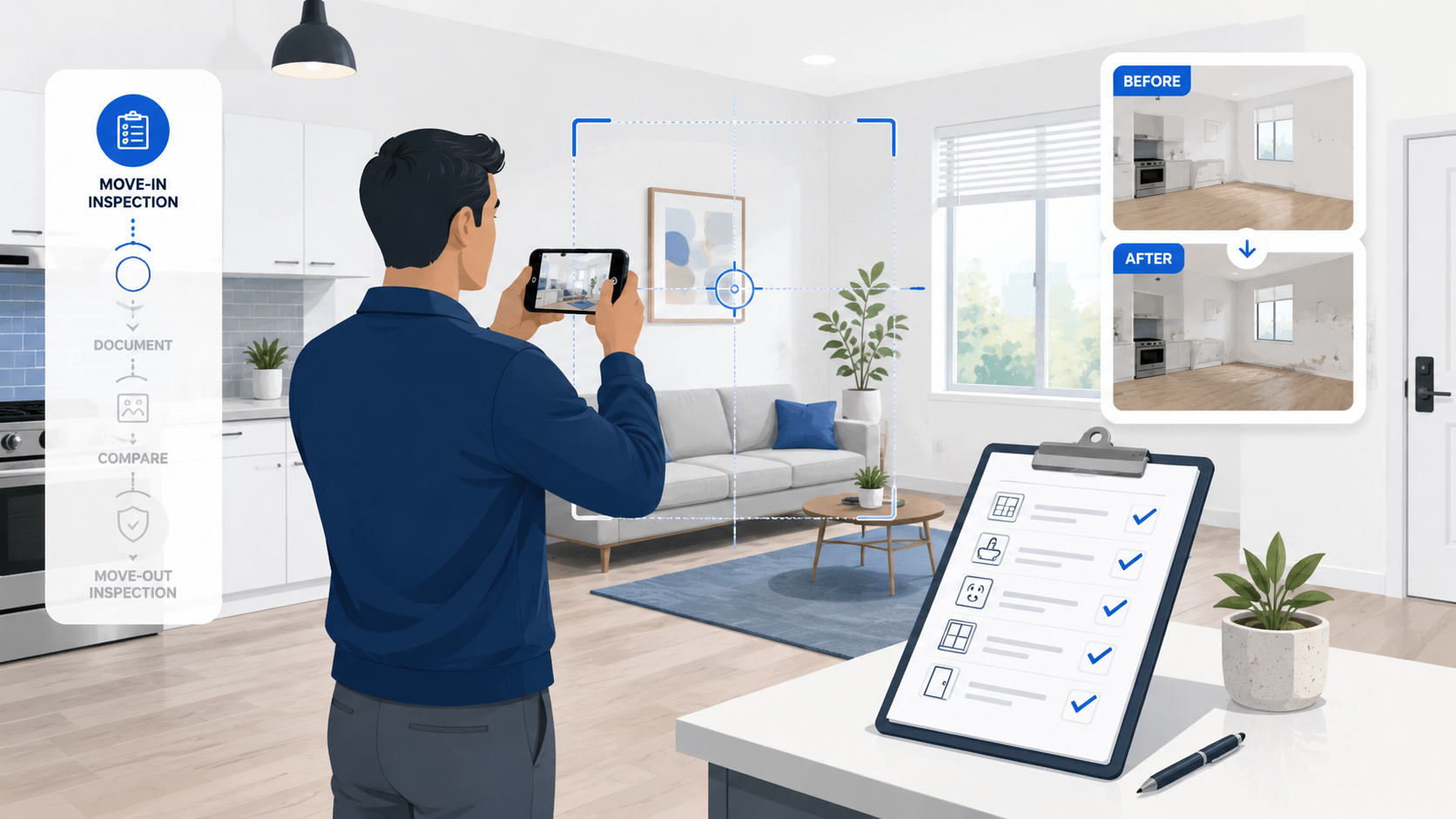
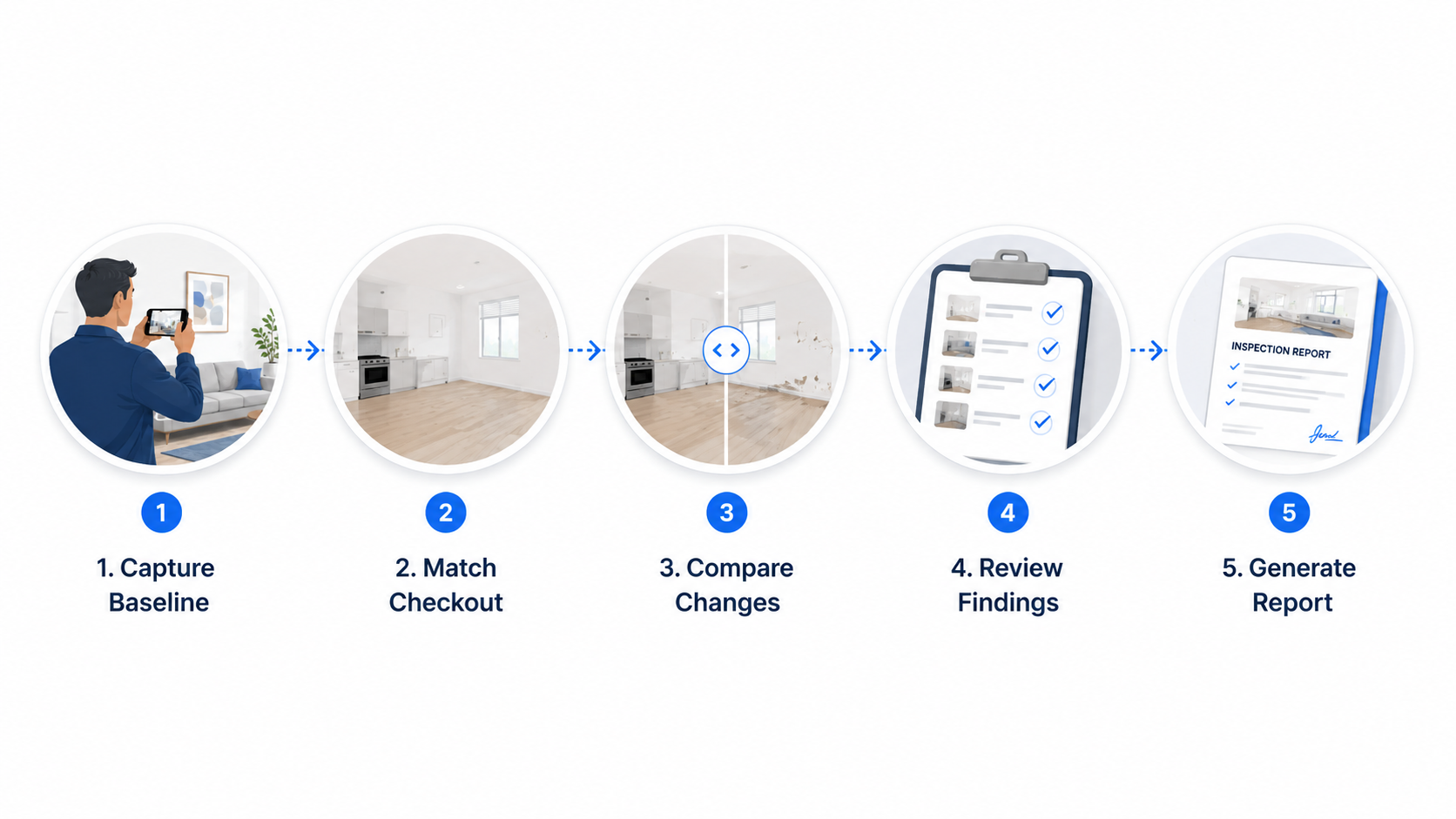
This simple process helps landlords create clearer documentation, review changes faster, and generate professional reports for move-in and move-out inspections.
1. Start with the baseline
The first move-in inspection is the most important one.
This is where you define the original condition of the property. It is also where you define the inspection path that future check-outs should follow.
The goal is not to take random photos of every corner. The goal is to create a clear visual record that can be repeated later.
A strong baseline should include:
each room captured in a consistent order
clear photos of walls, floors, windows, doors, fixtures, appliances, and furniture
similar camera height and distance whenever possible
enough coverage to understand the full room condition
timestamps and organized room labels
This baseline becomes the reference point for future inspections.
If the first inspection is rushed, incomplete, or inconsistent, every future comparison becomes harder. But when the baseline is strong, the move-out review becomes much easier.
The first inspection is not just documentation.
It is the standard.
2. Use the same room order every time
A repeatable inspection starts with a repeatable path.
For example:
Entry
Living room
Kitchen
Bathroom
Bedroom 1
Bedroom 2
Balcony, garage, or storage area
The exact room order does not matter as much as staying consistent.
When every inspection follows the same room order, it becomes easier to see what was captured, what still needs review, and whether anything was missed.
This is especially important when inspections are done by different people. A landlord, renter, staff member, cleaner, or property manager should be able to follow the same process without inventing a new inspection style every time.
The less the inspector has to decide, the more reliable the inspection becomes.
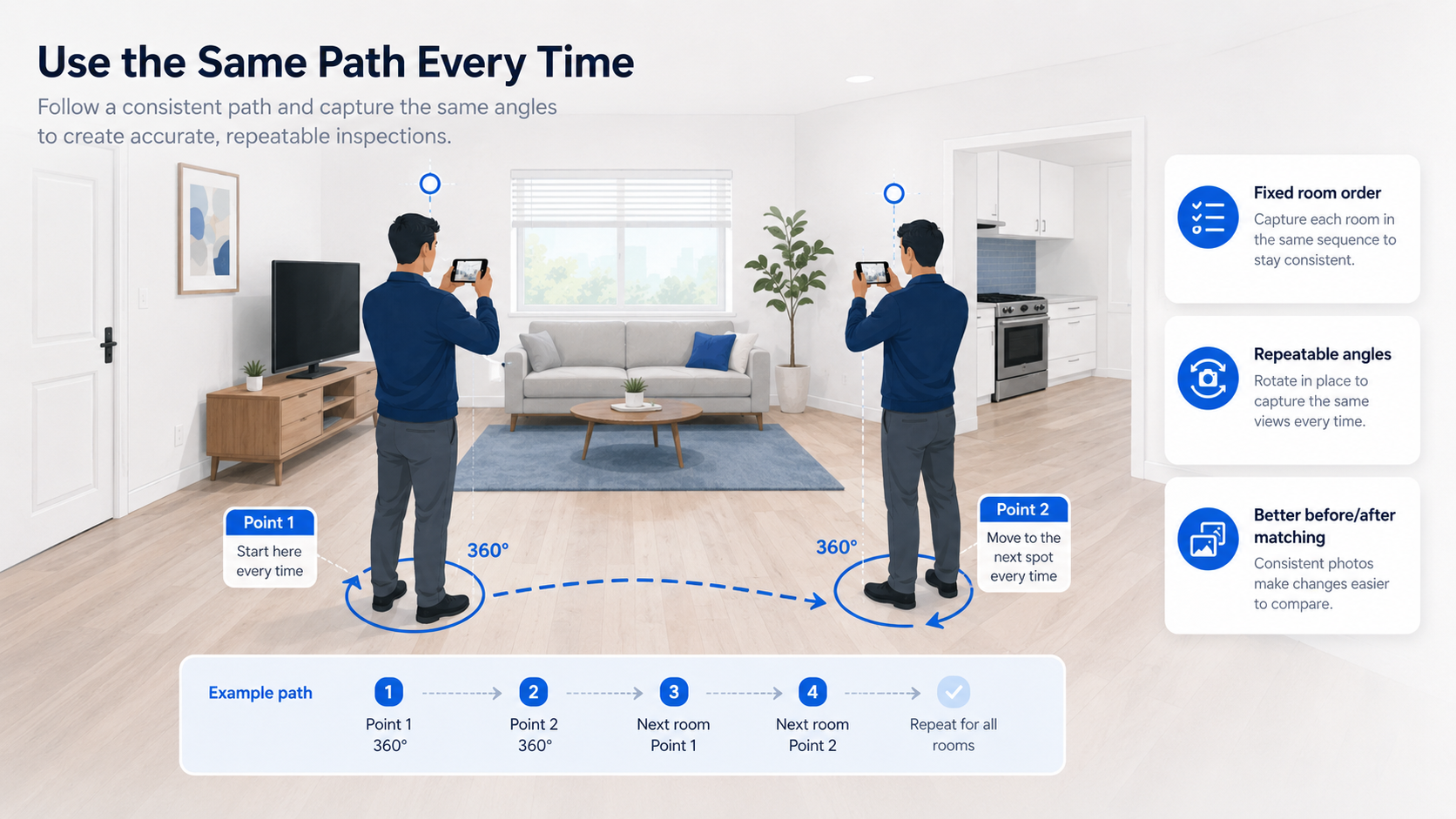
3. Use planned capture points
One of the easiest ways to improve inspection quality is to use planned capture points.
Instead of walking randomly around the room, choose one or two standing points in each room. From each point, rotate in place and capture the room from consistent angles.
For small rooms, one point may be enough.
For larger rooms, two points may work better.
The goal is to reduce movement and increase consistency. Movement creates drift. Rotation creates repeatability.
This matters because before-and-after comparisons work best when the checkout images match the original baseline as closely as possible.
Better matching means:
fewer confusing angles
less missing context
easier visual comparison
clearer review
stronger documentation
4. Focus on comparable visuals, not photo volume
More photos do not automatically create a better inspection.
Fifty random photos can be harder to review than ten well-matched photos.
A strong inspection should focus on comparable visuals. That means the move-out inspection should try to match the move-in inspection as closely as possible.
Important details include:
similar camera position
similar camera direction
similar lighting when possible
same room sequence
same key surfaces and fixtures
same open/closed state for cabinets, drawers, closets, and storage areas
This does not need to be perfect. Rental properties are real spaces, and conditions will change. But the closer the checkout follows the original capture, the easier it becomes to review what changed.
The goal is not beautiful photography.
The goal is useful documentation.
5. Capture what usually causes disputes
Every property is different, but some areas usually deserve extra attention.
During move-in and move-out, landlords should carefully document:
walls and paint
floors and carpets
doors and handles
windows and blinds
kitchen cabinets and countertops
sinks and faucets
appliances
bathroom fixtures
mirrors and glass
furniture and included items
outdoor areas, storage rooms, garages, or balconies
For furnished rentals, missing items can be just as important as visible damage.
A lamp, chair, remote control, mattress cover, small appliance, or wall decoration may not seem important during move-in. But if it is missing at checkout and there is no baseline record, the issue becomes harder to resolve.
The inspection should document property condition and included items clearly enough that future review does not rely on memory.
6. Let the checkout follow the move-in
The move-out inspection should not start from scratch.
It should follow the move-in baseline.
This is where guided capture matters. When the checkout follows the original inspection path, the landlord is not just collecting new photos. They are creating a comparable record.
The move-out process should answer:
Did this room change?
Is there new damage?
Is anything missing?
Was anything moved?
Does the condition match the move-in record?
Does this need to be marked for review?
A good checkout does not need to be emotional or argumentative. It should simply create a clear before-and-after record.
That is the power of a structured process.
7. Use AI to review changes faster
Manual review can become exhausting fast.
Even a small property can create dozens or hundreds of before-and-after comparisons. As the number of rooms, properties, or inspections grows, manual review becomes slower and easier to miss.
PropCheckAI is designed to help with this review step.
AI-assisted comparison can help:
compare before-and-after frames
surface visual changes
rank rooms by change activity
help users focus on areas that need attention
reduce time spent manually searching through every image
The important point is this:
AI helps review the inspection. It does not make legal or financial decisions.
The human stays in control.
The landlord, property manager, or responsible reviewer can confirm, dismiss, or manually mark issues before generating a report.
8. Review findings before creating the report
A strong inspection process should always include human review.
AI can help surface changes, but the user should decide what matters.
For example, a visual change may be:
actual damage
normal wear
moved furniture
different lighting
cleaning in progress
an item that was intentionally removed
something that needs more context
That is why review matters.
PropCheckAI is built around a human-in-the-loop process. The app can assist with comparison, but the user reviews the findings and decides what should be included in the final report.
This keeps the process practical, responsible, and flexible.
9. Generate a professional report
The final step is turning the inspection into a report.
A strong report should be organized, clear, and easy to review. It should not be a messy folder of random photos.
A useful inspection report may include:
property name or address
inspection type
inspection date
report generation date
room-by-room organization
before-and-after images
marked findings
notes
page numbering
report ID
clear summary information
This creates a self-contained record that is easier to share, store, and review later.
The report does not need to overclaim. It does not need to say who is responsible or what should be charged.
Its job is to present the condition record clearly.
10. Keep the system simple enough to repeat
The best inspection system is the one people actually use.
If the process is too complicated, people skip steps. If it depends on memory, people forget. If every inspection is done differently, the final record becomes harder to compare.
A strong move-in / move-out process should be:
simple
repeatable
room-based
visual
comparable
report-ready
That is the foundation of PropCheckAI.
Instead of relying on memory, scattered photos, and subjective notes, landlords can build a repeatable inspection workflow that makes property condition easier to document and easier to review.
Final takeaway
A rental inspection should not be random.
It should be designed once and repeated every time.
Start with a strong baseline. Follow the same room order. Use planned capture points. Match checkout images to the original inspection. Review changes carefully. Generate a clear report.
That is how move-in and move-out inspections become easier to compare.
And that is the system PropCheckAI is built to support.
Ready to make rental inspections easier to compare?
PropCheckAI helps landlords create structured visual records, review property changes faster, and generate professional reports for move-in and move-out inspections.